Commercial Heat Pump Funding: What the Boiler Upgrade Scheme Does and Does Not Cover for Businesses
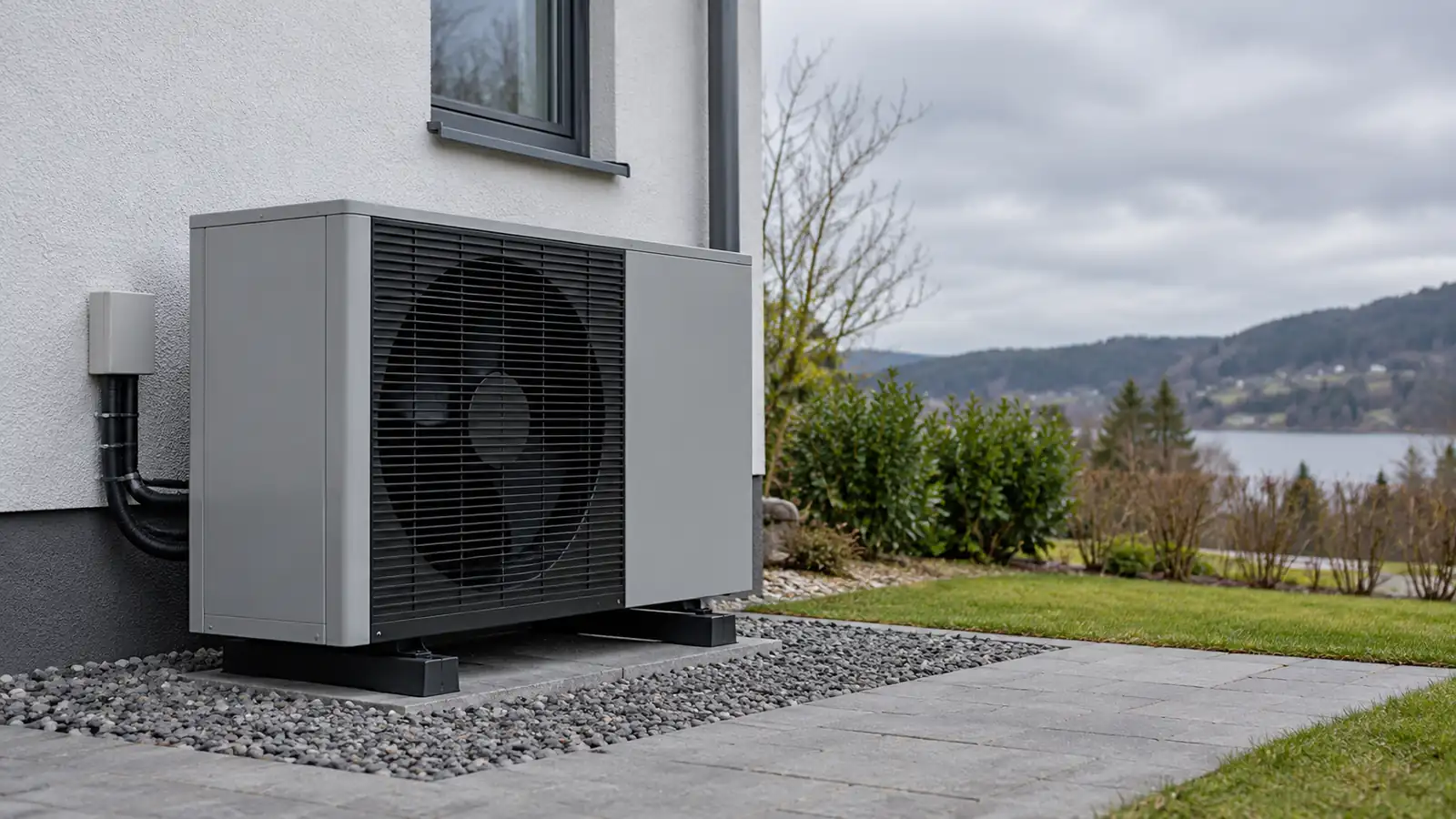
The most expensive misconception in commercial heating is that the Boiler Upgrade Scheme is a domestic programme. It is not. Business premises can claim, the grant is paid per installation rather than per household, and the capacity ceiling was raised substantially in April 2026 — which brought plant rooms into scope that were excluded a year ago.
What follows is the eligibility position, the amounts, the limits that actually bite, and the seven technical checks to run before an installer submits anything on your behalf. Where a figure depends on scheme rules that change, the source to check is named rather than guessed at.
What the scheme is
The Boiler Upgrade Scheme, administered by Ofgem, pays a fixed capital grant towards replacing a fossil-fuel heating system with a heat pump or, in defined circumstances, a biomass boiler. The grant is not a loan and not a tax relief. It is deducted from your installer's quote before you pay, and the installer recovers it from Ofgem — you never handle the money.
Two points that matter commercially. There is no income or means test, which is irrelevant for a company but worth knowing if you have been told otherwise. And since April 2026 the scheme no longer requires a valid EPC for the property, which removed a common blocker: previously an outstanding recommendation for loft or cavity wall insulation could stop an application outright.
The amounts
| Technology | Grant | Notes |
|---|---|---|
| Air source (air-to-water) heat pump | £7,500 | The standard route for most commercial retrofits. |
| Ground source or water source heat pump | £7,500 | Includes shared ground loop arrangements. |
| Heat pump in an eligible off-gas-grid property currently heated by oil or LPG | £9,000 | The standard £7,500 plus a £1,500 uplift. The uplift is time-limited and runs to March 2027. |
| Air-to-air heat pump | £2,500 | Not available for non-domestic property under regulation 9A of the scheme rules. |
| Biomass boiler | Confirm with Ofgem | Subject to its own rural and off-gas-grid conditions; capacity limit 70 kW thermal. |
The air-to-air exclusion is the single most common error we see in quotations. If a supplier has priced a VRF or air-to-air system for your commercial premises and shown a Boiler Upgrade Scheme grant against it, that line is wrong and the grant will not be paid. Air-to-air can be an excellent engineering answer for a commercial space; it is simply not a funded one here.
The capacity limit, as it now stands
From 28 April 2026 the scheme's capacity ceiling is 300 kW for heat pumps and 70 kW thermal for biomass. Any lower figure you find in an older guide, a contractor's brochure or a 2025 article has been superseded — and the earlier, much lower ceiling is why so many commercial sites were told, correctly at the time, that they did not qualify. If your plant was assessed against the old limit, it is worth reassessing.
Read the limit as applying to the installed capacity of the system being grant-funded, and size the system on a calculated heat loss rather than on the limit. Specifying up to a grant ceiling is how buildings end up with oversized plant that cycles, wears and underperforms on seasonal efficiency.
Where the scheme applies — and where it does not
The Boiler Upgrade Scheme operates in England and Wales only.
Northern Ireland is outside the scheme entirely. There is no Boiler Upgrade Scheme application route for a property in Belfast, Lisburn, Derry or anywhere else in Northern Ireland, and no MCS installer can submit one on your behalf. This is a frequent and costly misunderstanding, because the scheme is described in UK-wide media as though it were a national programme. If your site is in Northern Ireland, energy support is devolved and administered separately; the Department for the Economy holds the energy brief and is the correct starting point. Do not let a supplier build a Northern Ireland business case on a grant that does not exist there.
Scotland is also outside the scheme and runs its own arrangements for heat and energy efficiency support, with separate routes for domestic and business premises. Check the current Scottish programme directly rather than assuming equivalence.
If you operate sites either side of the Irish Sea, build the funding assumption per site. The same specification on the same company's balance sheet can attract £7,500 in Cardiff and nothing in Belfast.
Why your installer applies, not you
You cannot apply for the grant yourself. The application is made by an MCS-certified installer, and both the installer and the specific equipment must be certified. The practical sequence:
- You appoint an MCS-certified installer, who carries out a heat loss calculation and designs the system.
- The installer applies to Ofgem for a voucher against your property and the proposed installation.
- You are contacted independently to confirm you consented to the application. Answer it; an unconfirmed application stalls.
- The grant is shown as a deduction on your invoice. You pay the balance.
- The installer commissions the system, registers it with MCS and redeems the voucher.
Vouchers are valid for a limited period, which differs by technology, so confirm the current validity window with Ofgem or your installer before you agree a programme that might slip. Three consequences follow from this structure and are worth stating plainly: your choice of installer determines whether you get the grant at all; you should see the MCS certificate number and check it against the MCS register rather than taking it on trust; and a quote from a non-certified contractor, however good the engineering, cannot carry the grant.
If your site falls outside the scheme
Plenty of commercial sites will not fit — above 300 kW, process heat rather than space heat, a landlord relationship that blocks the works, or a Northern Ireland location. Routes worth investigating, by name, rather than inventing a funding line in your business case:
- Industrial decarbonisation funding for process heat and manufacturing sites, including the Industrial Energy Transformation Fund. Amounts and competition windows change; check what is currently open.
- Capital allowances. Plant and machinery reliefs can materially change the after-tax cost of a heat pump installation. The rates and the qualifying rules change with fiscal events, so take the current position from HMRC and your accountant, not from a brochure.
- Heat networks. If a network exists or is planned nearby, connection can be cheaper than on-site plant.
- Phasing. Where a single system exceeds the limit, a staged plant replacement with separately grant-eligible systems is sometimes legitimate. Have the installer confirm it against current scheme rules before you rely on it, because this is exactly the kind of structuring the rules address.
The economics, without the marketing
Do the arithmetic yourself; it takes ten minutes and it is the part suppliers most often skip.
For the gas boiler you are replacing, divide your actual gas unit rate in pence per kWh by the boiler's real seasonal efficiency — for a condensing boiler in commercial service, typically somewhat below its badged figure. That gives your current cost per useful kWh of heat delivered.
For the heat pump, divide your electricity unit rate by the system's SCOP at the design flow temperature you will actually run — not the headline figure at 35 °C if your emitters need 50 °C. That gives the new cost per useful kWh.
Electricity costs materially more per kWh than mains gas on typical non-domestic tariffs, so the entire operating case rests on that SCOP. A system running at a SCOP of 3.5 is a very different proposition from the same system forced to 2.4 by undersized emitters. Then add the things that do not appear in a unit-rate comparison: standing charges, any increase in your electrical capacity charge, maintenance and F-gas obligations on the new plant, and the removal of gas safety and flue inspection costs. Run the payback at your grant-adjusted capital cost, and run it again at an electricity price 20% higher and 20% lower. If the decision flips between those two cases, you are not looking at a payback, you are looking at a bet on tariffs.
Seven technical checks before anyone applies
- A room-by-room heat loss calculation. Not a rule of thumb, not the old boiler's rating. The old boiler was almost certainly oversized, and copying its output is the most common cause of a disappointing installation.
- Flow temperature and emitters. A gas system designed around 70–80 °C flow will not perform on a heat pump at 45–55 °C unless emitter area increases. Price the radiator, fan coil or underfloor changes as part of the project, because they decide the SCOP and therefore the running cost.
- Space and clearance for the external units. Air source plant needs unobstructed airflow in and out, clearance for the installer's stated service access, no short-cycling of discharge air back into the intake, and somewhere for defrost condensate to drain that will not ice a walkway in January.
- Electrical capacity. Check the available supply, the main switch rating and whether three-phase is present. Heat pumps of commercial scale frequently need a supply upgrade, and a distribution network connection can take longer than the whole rest of the project.
- Noise. The acoustic calculation under MCS 020 is assessed at a nearby habitable-room window, with 37 dB(A) as the threshold that decides whether a full planning application is needed. Barriers, anti-vibration mounts and night setback all help, but they are design decisions, not afterthoughts.
- Planning permission. For non-domestic premises there is permitted development for ground and water source heat pumps, but no equivalent class for air source. Assume an application is needed, and build its determination period into the programme. Listed buildings and conservation areas remove any remaining doubt.
- Hydraulics and water quality. System volume and buffering, flow rates through existing pipework, a proper flush and inhibitor, and strainers. Heat pumps are far less tolerant of a dirty, poorly balanced circuit than the boiler that put up with it for twenty years.
Get those seven answered in writing before an application is submitted. The grant is fixed; the cost of discovering a supply upgrade or a planning refusal halfway through the works is not.
Sources
- Ofgem — Boiler Upgrade Scheme rules, grant amounts and scheme updates
- Department for Energy Security and Net Zero — Boiler Upgrade Scheme guidance and eligibility
- MCS — installer and product certification requirements, and MCS 020 planning standard
- Department for the Economy (Northern Ireland) — devolved energy support
- HM Revenue & Customs — capital allowances on plant and machinery
- CIBSE — heat loss calculation and low-temperature system design guidance
- Planning Portal — permitted development and planning applications in England and Wales